





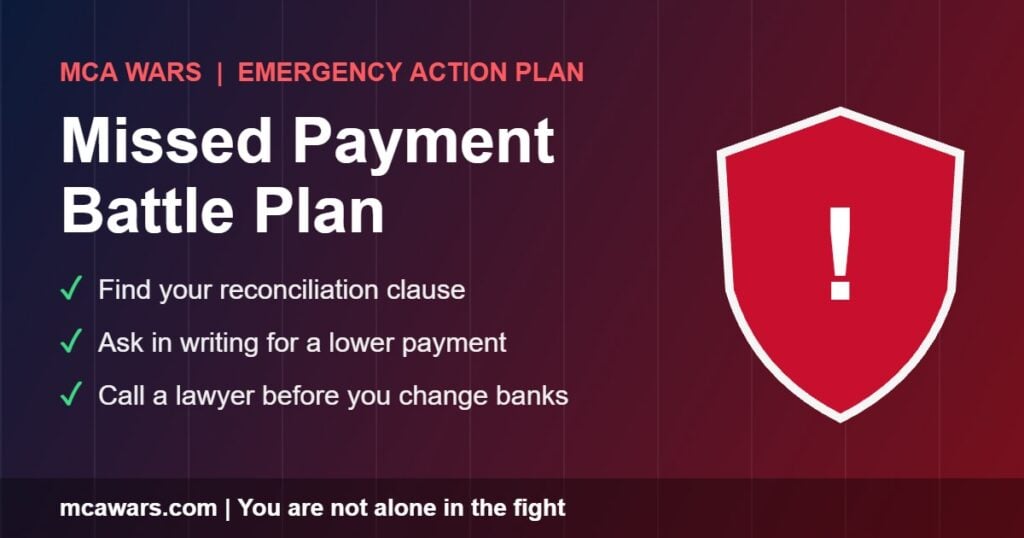
Quick answer: If you can’t make your MCA payment, act before the payment is missed. Read your contract for a reconciliation clause. Ask the funder in writing to lower your payment based on your real sales. Save every record. Then call a lawyer who handles MCA cases before you change banks or stop any debit.
The money is not there this week. The daily debit is coming anyway. Your stomach drops every time you open the bank app.
You are not the first owner to stand here. You will not be the last. A slow month, a lost client, or a late customer can do it.
This post is your emergency battle plan. It covers the first days, before a missed payment turns into a default. Move early, and you keep more of your options.
What happens if you can’t make your MCA payment?
An MCA is a merchant cash advance. A funder gives you cash now. In return, it buys a slice of your future sales. It takes that slice back with an ACH debit. ACH means an automatic pull from your bank account. Most MCAs pull daily or weekly.
If the debit bounces, the funder sees it fast. Most contracts call a failed payment a “default.” A default can trigger big fees. It can also make the full balance due at once.
Next, the funder may call you and anyone who signed a personal guarantee. A personal guarantee means you promised to pay with your own money if the business can’t. The funder may also send notices to your customers based on its UCC lien. A UCC lien is a public filing that claims your sales and assets as collateral.
Here is what funders do not tell you. I have worked in this industry since 2014. Most funders would rather adjust a payment than chase a lawsuit. A lawsuit costs them time and money too. But they only bend for owners who speak up early.
Step 1: Find the reconciliation clause
Pull out your contract today. Look for a section called “reconciliation” or “adjustment.” It may be buried near the end.
This clause says your payment should match your real sales. If sales drop, you can ask for a lower payment. The funder usually wants proof, like bank statements.
Why does this matter so much? An MCA is sold as a purchase of future sales, not a loan. Courts often look at the reconciliation clause to decide if that is true. In 2020, a New York appeals court said this clause is one key factor. The case was LG Funding v. United Senior Properties of Olathe.
So the funder has a reason to honor it. Use it.
Step 2: Ask for a lower payment in writing
Do not just call. Send an email too. Keep it short and calm.
- Say which contract you mean. Use the date and the contract number.
- Say your sales have dropped. Give the real numbers.
- Ask for a reconciliation under the contract.
- Attach your last two or three bank statements.
- Ask for a written reply by a set date.
Here is an example of the math. These numbers are only an example. Say your contract takes 10 percent of sales. You expected $100,000 a month in sales. So the funder set your debit near $10,000 a month. Now your sales fell to $60,000. Ten percent of that is $6,000. That is $4,000 less each month.
Save a copy of every email you send. Save every reply. This paper trail is a weapon later. Our post on the documents that win MCA battles shows what to keep.
Step 3: Build your emergency cash map
Know your enemy, but also know your own ground. Make a simple list of what must be paid this month.
- Payroll and payroll taxes
- Rent or lease
- Key suppliers who keep you open
- Insurance
- Each MCA debit and its date
Put each one on a calendar. Now you can see which week is the crunch. This map helps you talk to the funder with real facts. It also helps your lawyer see the whole fight.
Step 4: Know what not to do
Panic leads to costly mistakes. Steer clear of these:
- Do not take a new MCA to pay the old one. This is called stacking. It usually makes the hole deeper.
- Do not hide money or move assets to get away from a creditor. That can be a fraudulent transfer. It can be illegal and can make things far worse.
- Do not close your bank account or block the debits on your own. Your contract may call that a default. It can lead to a fast lawsuit. Talk to a lawyer first.
- Do not sign anything new in a rush. That includes a new deal or a confession of judgment.
A confession of judgment is a paper you sign ahead of time. It says the funder wins in court. Since August 2019, New York law has blocked these papers against people who live outside the state. Other states have their own rules. A lawyer can tell you what applies to you.
For more traps, read what never to do when fighting MCA collectors.
Step 5: Get help from the right people
You do not need to fight this alone. Talk to a lawyer who knows MCA cases. Some offer a free first call. Bring your contract, your bank statements, and your emails.
Has the funder already started calling or suing? Use our 72 hour counter offensive plan for when MCA collectors attack.
Your Battle Checklist
- Find and read your reconciliation clause
- Send a written request for a lower payment
- Attach real bank statements
- Map every bill and debit on a calendar
- Save every email, letter, and call note
- Do not stack, hide money, or block debits
- Call an MCA lawyer before you change banks
Common Questions
What happens if I miss one MCA payment? Most contracts call it a default. Fees may be added, and the full balance may come due. Calls to you and your customers may start soon after.
Can I ask my MCA funder to lower my daily payment? Yes, if your contract has a reconciliation clause. Ask in writing. Send proof that your sales dropped.
Should I change banks to stop MCA debits? Not on your own. It can break your contract and speed up a lawsuit. Talk to a lawyer first.
You Are Not Alone in the Fight
Other owners are in this war room with you. Join the MCA Wars Discussion group on Facebook to talk with owners who have been there. Subscribe to MCA Wars to get new battle plans as they post.
Facing a default or a UCC lien right now? Get a second set of eyes on your case.
Get Your Free Case Review at StopUCC
This article is for education only. It is not legal, financial, or tax advice. Laws are different in each state. Talk to a qualified professional before you make decisions about your business debt.
Created, Customized and Powered by Velocity Business LLC




More Stories
Emergency Restraining Orders: Stop Harassment Now
The Collector’s Playbook: What MCA Companies Do in Your First 48 Hours
Battle Plan: The 72-Hour Counter-Offensive When MCA Collectors Attack