





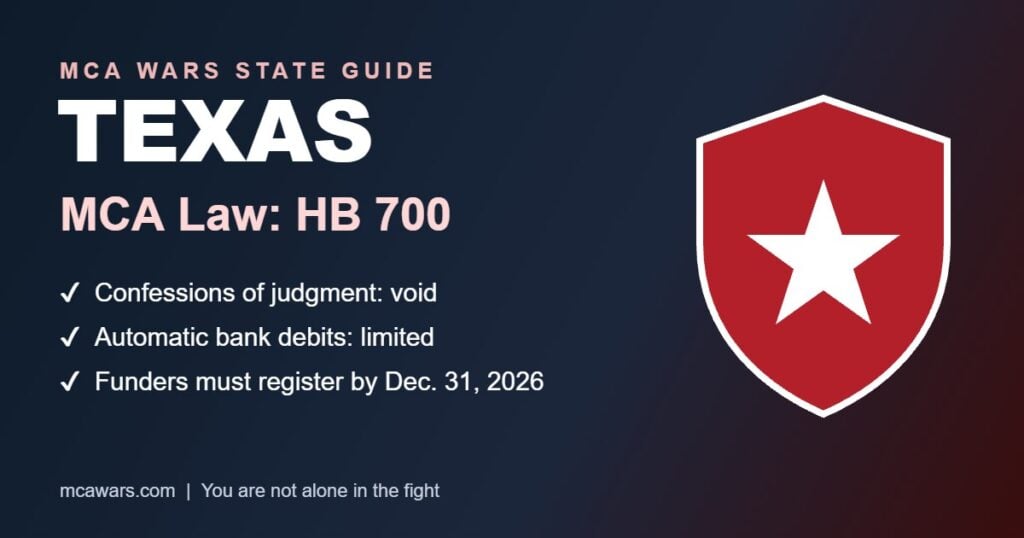
Quick answer: Texas now has a law just for merchant cash advances. It is called HB 700. It bans confession of judgment clauses in these deals. It limits when a funder can pull money from your bank on autopilot. And funders must register with the state by December 31, 2026.
If you run a business in Texas and you have an MCA, this post is for you.
An MCA is a merchant cash advance. A funder gives you cash now. In return, it buys part of your future sales. Then it takes payments from your bank, often every day.
For years, Texas had few rules for these deals. That changed in 2025. Here is what the new law means for you, and how to use it in your fight.
Know your enemy. Funders know this law well. Most owners do not. Let’s fix that today.
What Is HB 700?
HB 700 is a Texas law signed in June 2025. Most of it took effect in September 2025. The state agency that enforces it is the Office of Consumer Credit Commissioner. People call it the OCCC.
The OCCC wrote detailed rules for the law. Those rules took effect on July 9, 2026.
The law covers “sales-based financing.” That is the legal name for deals like MCAs. It covers funders. It also covers brokers. A broker is a person paid to set up the deal for you.
Weapon 1: Confession of Judgment Is Void
A confession of judgment is a paper you sign at the start. It says you already agree you owe the money. If the funder says you broke the deal, it can use that paper to get a court judgment. A judgment is a court order that says you owe. The funder can win without you ever going to court.
Texas has fought this for a long time. An older Texas law already limits it. You cannot confess a judgment in a paper signed before a lawsuit.
HB 700 goes further. It says a confession of judgment in a sales-based financing deal is void and cannot be enforced. The OCCC rules also list it as an unfair practice.
Here is what funders do not tell you: some contracts still have this clause. Many funders use one contract for every state. Seeing the clause does not mean it works against you in Texas.
Weapon 2: Limits on Automatic Bank Debits
An ACH debit is when a funder pulls money straight from your bank account. Most MCAs do this every day or every week. You sign a form once, and the pulls keep coming.
HB 700 limits this. A funder may not automatically debit your account unless it holds a valid, perfected, first-priority security interest. The OCCC rules say that interest must cover all of your accounts receivable.
Let’s break that down.
- A security interest is a legal claim on your business property.
- Perfected usually means the funder filed a UCC lien. A UCC lien is a public notice that says, “We have a claim on this business.”
- First-priority means the funder is first in line, ahead of other lenders.
Insider tip from the frontline: many MCA funders are not first in line. A bank loan or an earlier funder often holds that spot. This gets worse when owners stack two or three advances.
A warning before you act: this does not mean you can just stop paying. Your contract still matters. Blocking debits or changing banks can break your contract and spark a lawsuit. Talk to a lawyer before you change anything about your payments or your bank.
Weapon 3: Registration and Penalties
Some funders and brokers were doing business in Texas on September 1, 2025. They must register by December 31, 2026. New funders must register before their first deal. Registration runs through a national licensing system called NMLS.
The law sets a civil penalty of $10,000 for each violation. Doing business without registering after the deadline is a violation too.
The law also bans unfair, deceptive, or abusive acts in these deals. Wrong disclosures and unauthorized debits are on that list.
Weapon 4: Clear Disclosures
For offers under $1 million, the funder must show you key terms before you sign. If those numbers turn out wrong, it must tell you and send new ones.
Here is a simple example. These numbers are only an example.
- You get $50,000.
- The factor rate is 1.4. A factor rate is the number the funder multiplies your advance by to get what you pay back.
- You pay back $70,000. That is $20,000 more than you got.
- If you pay over 120 business days, that is about $583.33 a day.
Texas Shields Outside the MCA Law
Texas has other strong protections. These are older laws. They may help you if a funder sues you and wins.
- Your home. Texas homestead law has no dollar cap on value. It does have a size limit. A city home can be up to 10 acres. A rural home can be up to 200 acres for a family. For a single adult, it is 100 acres.
- Your paycheck. The Texas Constitution does not let most creditors garnish your current wages. Garnish means taking money straight from your pay.
These shields have limits and exceptions. They protect property you already have the right way. Never move or hide money or property to dodge a creditor. That can be a fraudulent transfer. It can be illegal, and it can make things much worse.
Your Battle Plan in Texas
- Get your contract. Find every page you signed.
- Look for a confession of judgment. Mark it.
- Check the UCC filings. Search the Texas Secretary of State records for liens on your business. See who is first in line.
- Check registration. After December 31, 2026, ask if your funder and broker are registered.
- Keep a log. Write down every call, letter, and bank debit.
- Call a Texas lawyer. Bring your contract, liens, and log.
To learn more, read our State Law Arsenal guide. You can also see how to file regulator complaints and how settlement talks work.
Your Battle Checklist
- I have a full copy of my MCA contract.
- I checked it for a confession of judgment clause.
- I searched for UCC liens on my business.
- I know who is first in line on my receivables.
- I have a log of every debit and every call.
- I will not stop payments or switch banks without a lawyer.
- I will not move assets to dodge a creditor.
Common Questions
Does HB 700 cancel my MCA? No. Your deal still exists. The law changes some rules the funder must follow. A lawyer can tell you how it fits your contract.
Can a funder still take daily ACH payments in Texas? Only in some cases. The funder needs a perfected, first-priority claim on all of your receivables. Debits you approve one at a time are treated differently. Ask a lawyer before you block anything.
Who enforces this law? The Texas Office of Consumer Credit Commissioner, or OCCC. It can investigate funders and brokers.
You Are Not Alone in the Fight
Join the MCA Wars Discussion group on Facebook to share what you face and learn from others. Subscribe to MCA Wars so you never miss a new battle plan.
Facing a UCC lien or an MCA default right now? Get help today.
Get Your Free Case Review at StopUCC
This article is for education only. It is not legal, financial, or tax advice. Laws are different in each state. Talk to a qualified professional before you make decisions about your business debt.
Created, Customized and Powered by Velocity Business LLC




More Stories